
Abstract
Plan Preview season for Stars 2027 has started. Good luck to every plan out there validating rates. While CMS litigation and shifting cut points keep the rest of the industry guessing, HEDIS is certain. That is the ground you can stand on. Whether you lead Stars specifically or quality across every line of business.
Where you are in the Plan Preview cycle:
- Now: Plan Preview 1. CMS provides plans their Stars 27 measure rates to validate.
- September: Plan Preview 2. Final scores, cut points, and technical notes arrive. With few exceptions, plan’s know where they landed for Stars 27.
- October 1: The Q4 push begins, and the CAHPS look-back window opens for Stars 28. Do you know which members are most likely to detract from your rating before that window closes?
- About a month after Plan Preview 2: Stars 27 (built on measurement year 25), goes public, while measurement year 26, your Stars 28, is already well underway.
Plan Preview brings actual performance to light. Quality work runs in three timeframes at once: past, present, and future. Plan Preview reflects your Stars 27 rating (built on measurement year 25 data) while you’re already deep into measurement year 26, Stars 28. A plan can come out of Stars 27 strong and be declining in Stars 28 already, or come out of Stars 27 rough and already be turning it around. Your Plan Preview results have arrived, and the reality of what needs to be done is setting in.
The plans that fare best, whether they’re protecting a strong rating or closing a gap, aren’t the ones who wait for the final number. They’re the ones who already know where their risk sits, and what protecting or closing it is worth.
The reality is stark: Chronic condition management and preventative care measures like CBP (Controlling High Blood Pressure), GSD (Glycemic Status for Diabetics), and BCS (Breast Cancer Screening) are major cost drivers for your plan. Traditional outreach campaigns struggle with low outreach response rates, no-shows, operational bottlenecks, and mysterious drop-offs that are nearly impossible to diagnose. You’re left wondering why members aren’t completing their annual wellness visits or why your team’s call-to-appointment conversion rates vary so dramatically.
Without clear visibility into these gaps and insight into how to optimize the resources you have, you’re flying blind on initiatives that directly impact both your quality scores and your bottom line. You already know your HEDIS performance and who’s compliant. What you don’t know is WHY gaps exist and WHAT TO DO about them.
Siftwell Pegasus: Your Unified Quality Intelligence Platform
We work with Quality teams that have identified targets but are challenged to close the gap of how to reach targets.
Siftwell’s Pegasus platform was built by health plan operators like you to transform how community health plans approach quality improvement by unifying your eligibility claims and operational data with over 15,000 proprietary data points.
You know who is non-compliant. You don’t know why, or what to do.
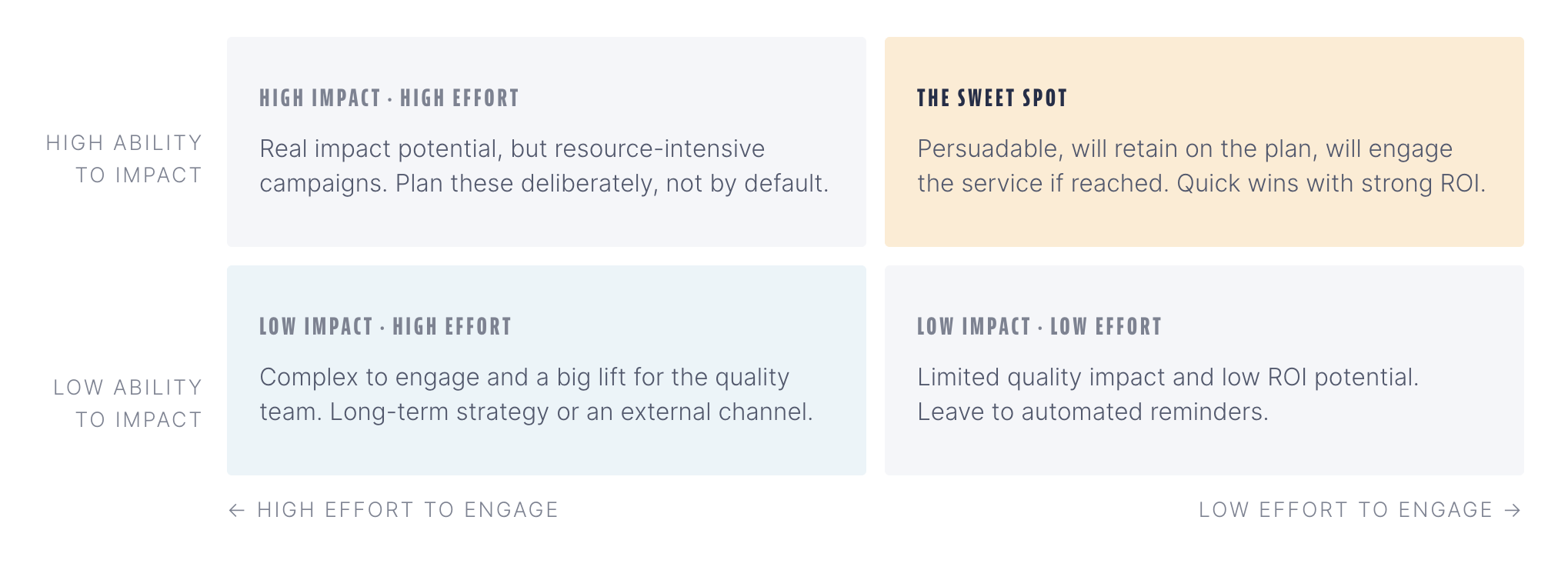
A flat gap list treats every member the same. Siftwell scores four groups on ability to impact against effort to engage. Clients concentrate limited resources on high-ability to impact and low effort, the quick wins, with strongest ROI. The other three still get a strategy, just a different one.
Target the Right Members at the Right Time
Machine learning models identify members most likely to close quality gaps, with predictive ROI modeling that shows expected outcomes before you launch campaigns.
Stop guessing. Start targeting with confidence.
Track Quality Measures That Matter
Monitor HEDIS improvement efforts across all chronic condition management (such as CBP, GSD, KED, EED, SPD) and preventative care measures (such as AWV, AAP, BCS, COL, AIS) in real time. Get instant visibility into target gaps and performance trends that cross Medicaid, Medicare, and Marketplace lines of business.
Operational Clarity Where You Need It Most
Campaign dashboards reveal exactly where member drop-offs occur and why. See if the issue is pickup rates, appointment scheduling, or attendance, then drill down to understand root causes like work schedule conflicts or childcare responsibilities.
Measurable Quality + Cost Impact
By improving chronic condition management and preventative care measures, Pegasus helps reduce unnecessary utilization while lifting your quality scores. Prevention and chronic condition management directly contribute to lower medical costs across your plan.
See Siftwell Pegasus in Action
Watch how community health plans use Pegasus to track, target, and close quality gaps, all in one place.
From unified data visualization to targeted member cohorts to campaign performance tracking, see how Siftwell Pegasus transforms quality initiatives from operational guesswork into data-driven success.
Key Benefits Summary:
- Predictive member targeting to determine persuadable, impactable member within high-priority care gaps, so effort is spent on those measures that will drive the biggest performance improvement
- Scenario modeling to determine greatest return on effort
- Operational Transparency that identifies drop-off points and reasons for noncompliance
- Cost Reduction through improved chronic condition management and preventative care
- Crossline Flexibility across all HEDIS measures and lines of business
Ready to Transform Your Quality Performance?
Stop struggling with disconnected data, unclear targeting, and operational blind spots.
Siftwell Pegasus unifies your quality initiatives with the intelligence and clarity you need to drive real results.
Prevention and chronic condition management are critical to controlling costs while improving member quality outcomes.
Let us show you how we can help your plan achieve both.